

If you run a software company, and you have a free trial, high bets it’s 14 days. Most likely nobody tested that number. It felt polite, a competitor had it, maybe the billing tool suggested it.
You are in good company. In a January 2026 survey of 200 software products by ChartMogul and ProductLed, 62 percent ran a 14-day trial, 14 percent ran 7 days and 14 percent ran 30. The report was not built to say which of those converts better, and it does not.
In September, RevenueCat, which runs subscription billing for mobile apps, published trial data from more than 17,000 apps. A full year of trials, August 2025 to July 2026, split by the plan the buyer chose. That split is the useful part.
The short version: a free trial should last as long as your buyer needs to see the result, plus a few days. In RevenueCat’s app data, yearly plans converted best after 17 to 32 day trials, monthly plans peaked at 10 to 16 days, and AI apps lost buyers past 16 days.
None of this is B2B software data, and a controlled experiment at a software company found that the shortest trial won. The long version has the numbers and the caveats.
Why most SaaS free trials are 14 days
Fourteen days is the default, and a default feels safe. (It is also exactly half a month, which is a very human way to pick a number.) A shorter trial feels stingy and a longer one feels risky, so two weeks sits in the middle and looks like a decision.
The same ChartMogul report has a number that has nothing to do with length. Only 20 percent of the trial products asked for a credit card upfront, and those trials converted 30 percent of signups into paying customers within six months, more than five times the rate of trials without a card. The report adds that a card requirement can blunt signups, so it is a trade, not a free win. Still, it tells you something about where the money is: in who starts the trial and how serious they are, not only in the number of days.
What 17,000 subscription apps say about trial length
RevenueCat looked at apps on the App Store and Google Play and compared trials of four days or less, 5 to 9 days, 10 to 16 days and 17 to 32 days. For each group they measured two things: how many trial users became paying subscribers, and how many of those paid again when the first renewal came round. The figures are medians across apps.
Before the numbers, the limits, because they matter here.
These are mobile subscription apps, mostly bought by consumers, not B2B software bought by a team. RevenueCat itself calls the trial-length result “a correlational pattern, and a flattering one”. Their own example: someone still in your trial on day 25 of a 30-day window is simply more likely to pay. Annual buyers who convert after a long trial may already be the ones less likely to cancel. And the SaaStr write-up of the study, by Jason Lemkin, comes with a disclosure he makes himself: SaaStr Fund made the very first investment in RevenueCat back in 2018.
None of that makes the data useless. Read it as a direction (a well-lit one, with 17,000 apps behind it) and not as a law.
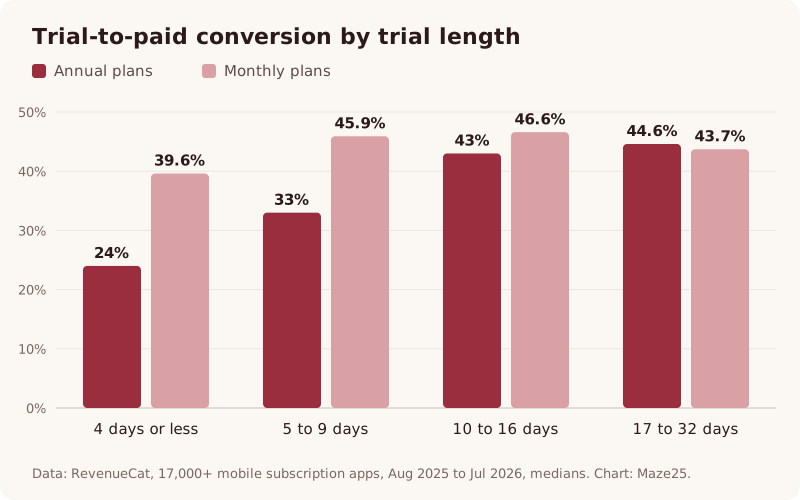
Free trial length for annual plans: longer trials, more buyers
On yearly plans, conversion went up with every step in trial length:
- four days or less: 24 percent
- 5 to 9 days: 33 percent
- 10 to 16 days: 43 percent
- 17 to 32 days: 44.6 percent
Look at the last step. Going from two weeks to a month added only 1.6 points of conversion. What it added was loyalty. Among people who paid, the share who renewed after the first year was 36.4 percent after a 10 to 16 day trial and 47.5 percent after 17 to 32 days. After the shortest trials it was 18.3 percent.
RevenueCat also counted the people who did both, paid and then renewed once, out of everyone who started a trial. That number went from 3.5 percent after the shortest trials to 18.5 percent after the longest. More than five times as many customers still there after a year, from the same number of trial starts.
It makes sense if you think about the purchase. A year is a bigger commitment than a month. A buyer who is about to pay for twelve months wants to be sure, and a short trial pushes them to decide before they are. Some say no. Some say yes and leave at the first renewal.
Lemkin’s reading for annual plans is blunt: go with a 30-day trial, absent evidence otherwise. He also argues that “the consumer skew matters less than you’d expect, especially on annual plans”. That is his opinion, not something the data shows, but it is a fair one: a yearly prepayment is closer to a contract than a monthly subscription is.
Free trial length for monthly plans: about two weeks
Monthly plans tell a different story: 39.6 percent after four days or less, 45.9 after 5 to 9 days, 46.6 after 10 to 16, and then down to 43.7 after 17 to 32.
Conversion peaks at 10 to 16 days and falls after that. Renewals among payers keep climbing (54.2, 62.8, 72.0 and 77.5 percent across the same groups), so a long monthly trial trades buyers for loyalty. Fewer people pay, the ones who do stay longer.
For a monthly product that is usually the wrong trade, because the buyer can leave any month anyway. Lemkin’s suggestion for self-serve B2B on monthly plans is about 14 days, and to go longer only if churn costs you more than conversion does. Which, for once, makes the default look reasonable.
How long should a free trial be for an AI product?
Two weeks at most, because every free day has a cost. AI products have a problem that ordinary software does not. A free user on a spreadsheet tool costs you almost nothing. A free user on an AI tool costs you every time they press the button.
RevenueCat split AI apps out. On monthly plans, trials of 5 to 9 days and 10 to 16 days converted almost the same, 38.2 and 38.5 percent. Trials of 17 to 32 days converted 31.8 percent, and renewals did not improve (64.2 percent among payers after 10 to 16 days, 64.1 after 17 to 32).
I expected the long trials to at least buy more loyal customers, the way they do on annual plans. They did not. The extra two weeks bought fewer customers and a bill for all the free usage in between.
RevenueCat’s own line: if your app has a real per-user cost behind every session, that spend adds up whether or not the person converts. Lemkin puts it shorter: every free session burns inference. His suggestion for B2B AI products is about two weeks as the ceiling on time-based trials, and if a buyer needs longer to evaluate, give them a usage cap (credits, runs, seats) instead of more days.
On annual plans the AI picture points the other way, as it did for apps in general: 23.3 percent conversion after 5 to 9 day trials, 33.8 percent after 10 to 16 days.
Is there B2B evidence on free trial length?
Less than you would want. None of the B2B reports above compares conversion across trial lengths. The closest thing is an experiment.
Hema Yoganarasimhan, Ebrahim Barzegary and Abhishek Pani worked with a large SaaS company that randomly gave new users a 7, 14 or 30-day trial. Random assignment is what the app data lacks: nobody chose their trial length, so the people in each group were alike. The best single rule was a 7-day trial for everyone, with 5.59 percent more subscriptions. (Against which of the other two lengths, the abstract does not say. I would read the gain as modest.) In the version later published in Management Science the authors write that shorter trial lengths, surprisingly, maximise customer acquisition, retention and profitability. They also found that long stretches of inactivity at the end of a trial go with lower conversion, and that experienced users got more out of longer trials than beginners did.
That is one company, first circulated in 2020, with a gain of a few percent. It is still the only randomised test at a software company among the sources here, and it went the other way from the app data.
The second piece of B2B evidence is about timing, not length. ChartMogul’s go-to-market report, built on about 2,500 SaaS companies from early 2024 to early 2025, found that trial-to-paid conversions spike around day 7, “likely when free trials end”. The daily rate sits close to zero until the last day. Their example: 16 percent of B2C trials converted within 7 days against 2.5 percent for B2B.
Put the two side by side. Most people who pay seem to pay when the clock runs out. A longer trial moves the deadline, but it only moves the decision if the buyer is still using the product when the deadline comes. The experiment above saw the same thing from the other side: long quiet stretches at the end of a trial went with fewer buyers.
Time to value: the number that actually sets trial length
The most useful story in all this is a small one. Daphne Tideman, writing on RevenueCat’s blog in March 2026, describes a wellness app she worked with that A/B tested a 7-day trial against a 14-day one. “While the longer trial drove slightly more trial starts, fewer people converted overall.” Not because people were abusing it or needed more time, she writes, but because activation did not improve. They went back to 7 days.
Her rule is the one to keep: trial length should align with activation time, not pricing norms or industry practices.
Activation is the moment your buyer sees the thing they came for. The first report that is actually right. The first invoice that goes out from your tool instead of the old spreadsheet nobody admits they still use. The first booked call. If that moment comes on day two for most of the people who end up paying, a 30-day trial gives the rest four weeks to forget you exist. If it comes on day twelve, after a data import and a colleague’s sign-off, a 7-day trial ends in the middle of setup and you never find out what they would have thought.
So the honest answer to “7, 14 or 30 days?” is another question: how many days does it take your paying customers to reach that moment? You probably have that number already, somewhere in your product data. Add a few days of margin for the buyer who gets busy, and that is your trial.
Free trial length by plan: a three-line rule for founders
If I had to set a trial tomorrow without testing anything, my rule would be:
| Your plan | Trial length to start with | What the data shows (RevenueCat, 2026) |
|---|---|---|
| Annual | One full cycle of the job your product does, up to about 30 days | 44.6% converted after 17 to 32 days against 24% after four days or less; 47.5% of payers renewed against 18.3% |
| Monthly | About 14 days, shorter if the result shows up in a day or two | Conversion peaked at 46.6% for 10 to 16 days and fell to 43.7% for longer trials |
| AI product | 14 days at most, then a usage cap rather than more days | 38.5% converted after 10 to 16 days against 31.8% after 17 to 32, with no gain in renewals |
The annual line is the generous one because a year is a lot to ask of someone who has not seen the product work. The AI line is the strict one because every free day is a cost, and in the app data the extra days did not bring better customers.
And the caveat that goes with all three. The biggest dataset is mobile apps, the software experiment covers a single company, and the B2B reports count trial lengths without comparing them. Lemkin, who argues for long annual trials, says it himself: run the test on your own funnel before you change pricing pages across the board.
Fourteen days is not wrong. It is just a default, and a default is a decision someone else made for a buyer who is not yours.
Questions people ask
- How long should a free trial be for a SaaS product?
- Long enough for the buyer to see the result the product promises, with a little room. In RevenueCat's data on more than 17,000 subscription apps, annual plans converted best after trials of 17 to 32 days and monthly plans after 10 to 16 days. That data is from mobile apps, not B2B software, so treat it as a starting point.
- Is a 7-day or a 14-day free trial better?
- It depends on how fast the buyer gets value. In a randomised experiment at a large software company, a 7-day trial for everyone beat 14 and 30 days. A wellness app that tested 7 against 14 days went back to 7: the longer trial brought slightly more starts and fewer paying customers, because activation did not improve.
- Do longer free trials convert better?
- On annual plans in RevenueCat's app data, conversion rose with every step up in trial length, from 24 percent to 44.6 percent. RevenueCat calls the pattern correlational: someone still in a trial on day 25 of 30 is more likely to pay anyway. On monthly plans, conversion dropped past 16 days.
- Should an AI product have a free trial?
- Yes, but a short one. AI apps on monthly plans converted at 31.8 percent after trials of 17 to 32 days against 38.5 percent after 10 to 16, and every free session costs inference. Jason Lemkin of SaaStr puts the ceiling for B2B AI products at about two weeks and suggests a usage cap instead of more days.
- Should a free trial require a credit card?
- It is a trade. In ChartMogul and ProductLed's 2026 survey of 200 software products, only 20 percent of free trials asked for a card upfront, and those converted 30 percent of signups into paying customers within six months, more than five times the rate without a card. The same report warns that a card requirement can blunt signups.