

A demo request lands at 2:40 on a Tuesday afternoon. You are on a call with a customer, then another one, and you see the notification at six. A small cold feeling in the stomach: they filled that form in hours ago. Are they still waiting, or already talking to someone else?
Then the number every sales blog repeats comes to mind. Call within five minutes and you are 21 times more likely to qualify the lead. You were more than three hours late, so it is gone, right?
Not quite. The number is real, but it measured something much narrower than the posts say, and it is 19 years old.
The short version: answer a demo request within one working hour, as a real person, with a link to book a time. The famous five-minute figure comes from a 2007 study of phone callbacks that measured reaching and qualifying leads, not closed deals. Newer vendor data puts the average reply at hours, so an hour puts you ahead.
The long version has where the number comes from, what it counted, what the newer data says, and the rule I would use.
Where the 5-minute lead response time study comes from
The number goes back to one presentation. On 16 October 2007, at a MarketingSherpa summit on B2B demand generation, Dave Elkington, the CEO of InsideSales.com, and James Oldroyd, then a faculty fellow at MIT, presented the Lead Response Management Study. That is why you see it called “the MIT study”.
What they had, in their own words: “3 years of data across six companies that generate and response to web leads, from over fifteen thousand leads and over one hundred thousand call attempts.” Every lead was a web form that a sales rep then called back by phone. The data came from the InsideSales.com system, and InsideSales.com sold lead response software. The write-up also says the company had “a heavy concentration” of customers “from the mortgage and insurance industries”.
Hold that picture for a second: six companies, phone callbacks, and a vendor whose customers were concentrated in mortgage and insurance. (The write-up does not say which industries the six companies were in.)
The other name you will see next to the number is Harvard Business Review. In March 2011 Oldroyd, Kristina McElheran and Elkington published “The Short Life of Online Sales Leads” there, with the line “Our research shows that most companies are not responding nearly fast enough.” The article’s own figures sit behind a paywall, so the HBR numbers that circulate on vendor pages are left out here. The 21 times and the 100 times come from the 2007 study.
What “21 times more likely to qualify” actually measured
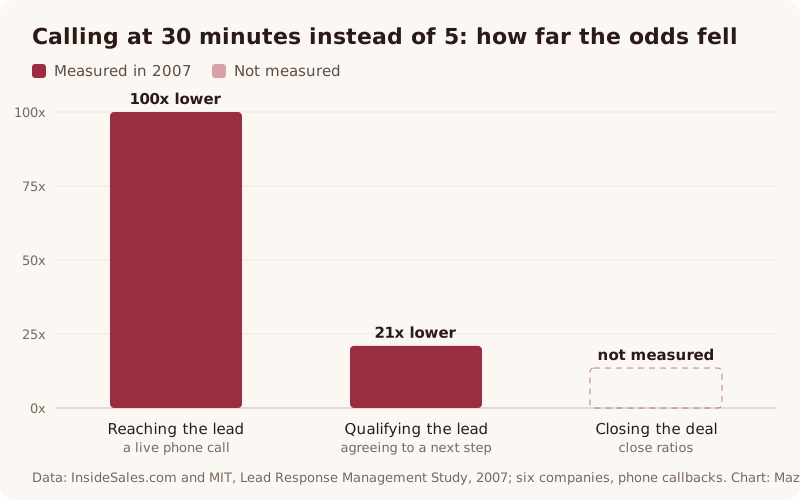
Here are the two famous lines, word for word: “The odds of contacting a lead if called in 5 minutes versus 30 minutes drop 100 times. The odds of qualifying a lead if called in 5 minutes versus 30 minutes drop 21 times.”
Two words in there carry everything: contacting and qualifying.
A contact was a phone call that reached a live person and lasted a set length (each company set its own, somewhere between two and six minutes). A qualified lead was one “willing to enter the sales process”, which in some cases meant booking an appointment with a rep. Each of the six companies used its own definition.
And then the sentence almost no statistics roundup repeats: “This study did not address close ratios.”
So the 21 times is about the odds of getting a person on the phone and getting them to agree to a next step. It says nothing about revenue. That is still worth something (no next step, no deal). But a founder who reads “answer in five minutes and sell 21 times more” is quoting a study that does not exist. Even “21 times more likely” is a stretch: the study talks about odds, and 21 times the odds is not the same as 21 times the chance.
There is a scene in the write-up that explains the urgency better than its charts do. To test the idea, the company’s president asked a big lead provider for mortgage quotes. He got seven calls. The first came after 30 minutes, the last three days later. The authors assumed each of their test leads had gone to between four and seven buyers. In that market the lead is shared, and whoever rings first is talking while the others are still dialling.
A demo request for your product is a different animal. The buyer found you, picked you and filled in your form, on your own site. They may fill in two other forms that afternoon (people compare, and they should), but nobody is reselling your form to six of your competitors. Speed still matters. The panic, though, comes from the write-up’s own examples, and they come from a market where it made more sense.
Further down, the write-up has findings that aged better than the headline. The odds of reaching a lead dropped “by over 10 times in the first hour”. And: “After 20 hours every additional dial your salespeople make actually hurts your ability to make contact to qualify a lead.” In plain words, the first hour mattered a lot, and in their data, every extra call after the first 20 hours made things worse, not better.
Lead response time statistics: the average B2B reply takes hours
Newer data says the bar is low. Embarrassingly low.
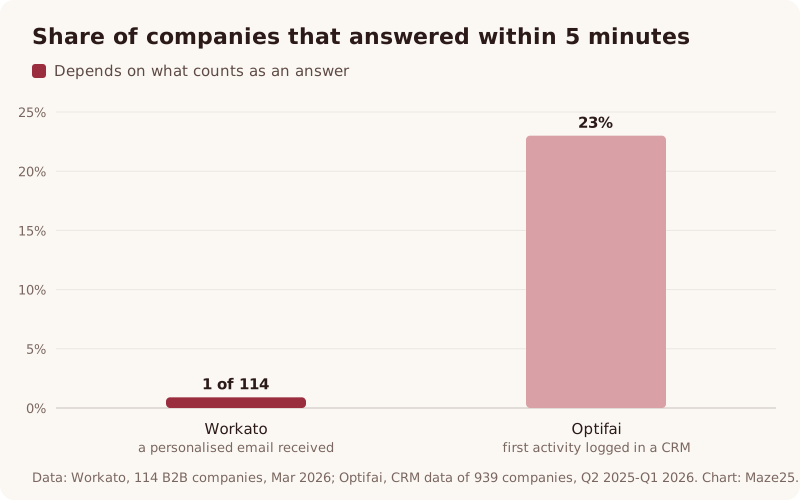
Workato, which sells automation and lead-routing software, published a study of 114 B2B companies in March 2026 (the page was last edited on 30 September). Its researchers filled in demo requests at each company and timed what came back. The headline: “More than 99% of companies aren’t responding within 5 minutes.”
The detail is worse. “Only 1 of the 114 companies sent a personalized email within 5 minutes.” The average personalised email took 11 hours and 54 minutes. Nearly one company in five never answered by email at all. Only 31 percent phoned, those calls took 14 hours and 29 minutes on average, and none came within five minutes. Companies with a lead-routing tool answered in 3 hours 32 minutes on average, companies without one in nearly 13 hours.
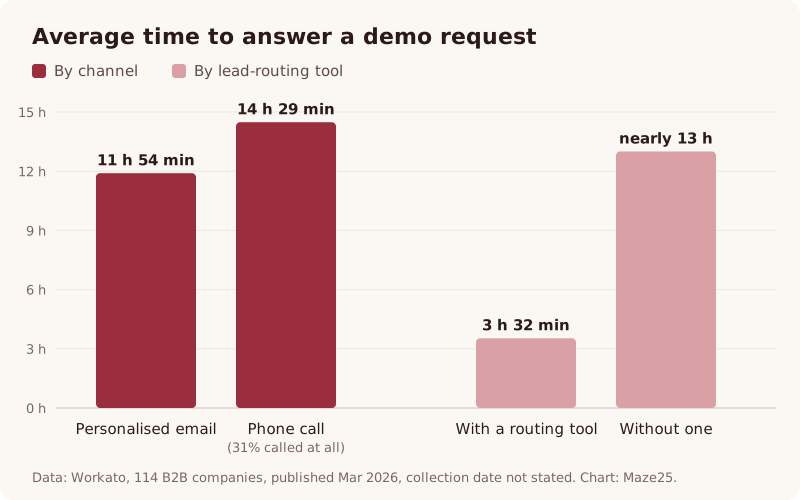
Now the small print, which belongs right next to those numbers. Workato sells the routing tool it measured, so the gap between tool and no tool is the part to read with the most care. And the page does not say when the requests were sent; the chart images on it sit in a 2020 upload folder, so the data may be older than the March 2026 date on top.
Optifai, which sells a sales pipeline platform, published benchmarks from CRM data covering the second quarter of 2025 to the first quarter of 2026. It counts the time from the moment a lead is created to the first sales activity, a “call, email, or meeting booked”. Its average: 47 hours. In its data 23 percent of companies answered within five minutes and 42 percent took longer than a day.
Twenty-three percent inside five minutes, against Workato’s one company in 114. Both can be honest, because they count different things. One counted a personalised reply that a researcher actually received. The other counts the first activity logged in a CRM. What counts as an answer changes the answer.
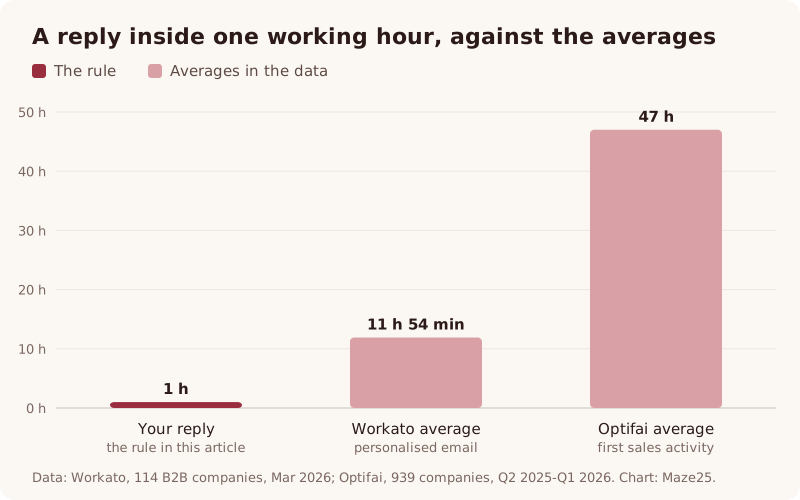
Either way, the picture for a founder is the same, and for once it is good news. A personal reply inside the hour beats the average in both datasets by hours: by more than ten in Workato’s, by more than a day and a half in Optifai’s.
Does a faster response close more deals?
Maybe. None of the sources here can tell you how much, least of all for a company your size.
Optifai is the only source here that reports close rates by response time, and it counts them on won and lost deals, not on every lead that came in. Deals where the lead got a first response in under five minutes closed at 32 percent. Five to 30 minutes, 24 percent. Thirty minutes to an hour, 18. One to 24 hours, 15. More than a day, 12.
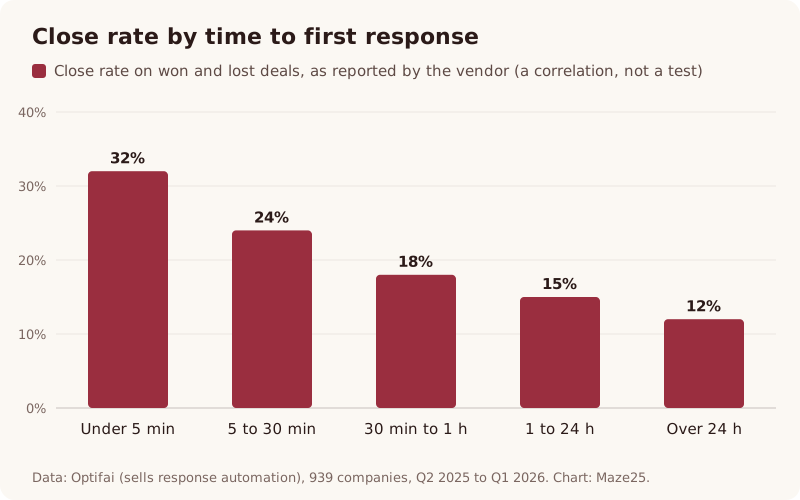
It looks like a clean staircase, and it is the most quotable number on the page: 32 against 12 percent is a little over two and a half times. Read the limits before you lean on it, though. It is a correlation from CRM records, not a test. Nobody assigned leads to fast or slow answers, and companies that answer in five minutes are probably better run in other ways too: they have someone free, a clear process, maybe better leads to begin with. The page calls its sample “939 B2B companies” in one place and “939 B2B SaaS companies” in another, and its own summary lists “<1 hour: 24%”, the same figure its chart gives for 5 to 30 minutes, without saying how the two fit together. And Optifai sells the fix it measures.
My reading: the direction is believable, the size is not proven. You do not need a precise multiplier to decide that a buyer who asked for a demo deserves an answer the same day.
What a good reply to a demo request looks like
Speed is half of it. The other half is whether the reply sounds like a person.
Workato counted personalised replies separately, and I think that is the right thing to count. My guess at how the buyer reads the automatic “Thanks, someone from our team will be in touch”: not as an answer, more like a ticket number. Two or three sentences that name what they actually asked for feel like somebody read the form. (Same thing that gets a cold email answered: proof that someone looked.)
Put a booking link in it. Every “does Thursday work?” is one more round of waiting.
And send it from the person who will run the call, which in a small company may well be you, the founder, whether you planned it that way or not, because a handover from a shared inbox to a rep to someone’s calendar adds a wait at every step, and the buyer, who has no idea how your team is organised and does not care, only notices that the conversation keeps changing hands.
Out of hours, an honest auto-reply is fine, something like: “Got it. I answer requests on weekday mornings, so you will hear from me by 10 on the next working day, Toronto time.” Being told when feels so much better than being told nothing. One sentence.
If they asked for a call, call within the hour and switch to email if nobody picks up. That 2007 finding about extra dials after 20 hours is old and came from phone-heavy sales, but it still sounds right to me.
I get why this feels heavy. Nobody wants to be the founder who checks the inbox between every meeting. It is not that, though. It is one notification you never let sit past the hour.
Lead response time: a founder’s rule
If I had to set the rule tomorrow for a company of five to thirty people, it would be this:
| When the request comes in | What to do | What the data shows |
|---|---|---|
| During working hours | A reply from a person within one working hour, with a link to book a time, from whoever will run the call | Workato: average personalised email 11 h 54 min; 1 of 114 companies replied within 5 minutes |
| Outside working hours | An honest auto-reply that says when you will answer, then a personal reply first thing | Optifai: average first response 47 hours; 42% of companies take more than a day |
| They asked for a call | Call within the hour; if nobody picks up, email; after the first day, write rather than ring again | 2007 study: odds of reaching the lead fell more than 10 times in the first hour; after 20 hours each extra dial hurt |
| Deciding whether it is worth the effort | Treat the close-rate gap as a direction, not a promise | Optifai: on won and lost deals, 32% close rate under 5 minutes, 12% after a day; a vendor’s correlation |
Why the hour and not five minutes? The five minutes was measured in 2007, on phone callbacks to web leads, by a vendor whose customers leaned heavily to mortgage and insurance. For a founder who is also the person running the demo, five minutes means never being in a meeting. An hour of working time is a promise you can actually keep: if you work 9 to 5, a request at 4:30 gets its answer by 9:30 the next working morning. It is a practical target, not an optimum any study proved, and it already beats the average in both newer datasets, and more than half of the companies in Optifai’s.
The buyer who fills in your form on a Tuesday afternoon is not holding a stopwatch. They are noticing whether anybody is home.
Questions people ask
- How quickly should you respond to a lead?
- Within one working hour, with a reply from a real person and a link to book a time. The often-quoted five minutes comes from a 2007 study of phone callbacks to web leads. Two newer vendor datasets put the average B2B reply at about 12 hours and 47 hours, so an hour already beats both averages.
- What did the MIT lead response study find?
- Across six companies, 15,000 web leads and 100,000 call attempts, the odds of reaching a lead by phone were 100 times worse at 30 minutes than at 5, and the odds of qualifying it 21 times worse. The 2007 study by InsideSales.com and MIT's James Oldroyd says it did not address close ratios.
- Is the 5-minute lead response rule from Harvard Business Review?
- No. The 5-minute, 21 times and 100 times figures come from the 2007 InsideSales.com and MIT study. Harvard Business Review published a related article in 2011, 'The Short Life of Online Sales Leads', by two of the same authors with Kristina McElheran.
- What is the average B2B lead response time?
- It depends on what counts as a response. Workato filled in demo requests at 114 B2B companies and got a personalised email after 11 hours 54 minutes on average. Optifai's CRM data from 939 companies puts the average first sales activity at 47 hours.
- Does responding faster to leads increase sales?
- In Optifai's CRM data, among won and lost deals, those where the lead was answered in under five minutes closed at 32 percent against 12 percent when the answer came after a day. That is a correlation from a vendor that sells response tools, so read it as a direction. The 2007 study measured contact and qualification, not closing.